Twelve Feet
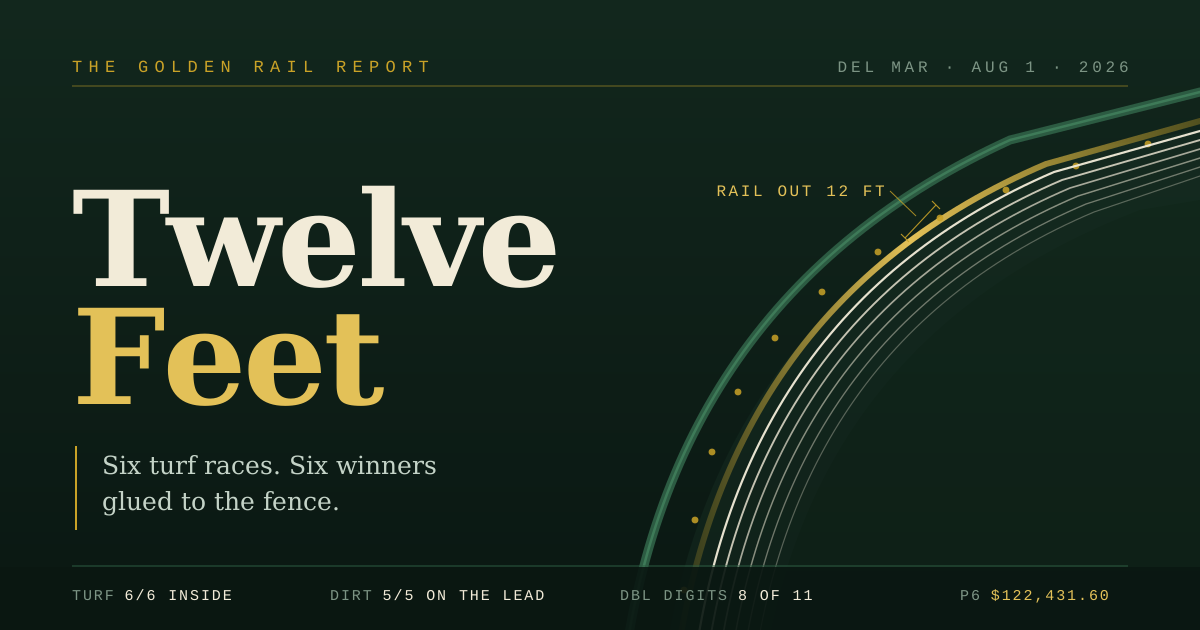
Del Mar, Saturday, August 1. The rail was at its mildest setting of the meet and the turf course still played like a one-lane road.
There is a version of this game where you do the work, get the read right, write it down in advance, and then talk yourself out of it at the window. I lived that version on Saturday. It was still a profitable afternoon — $274 out, $678.60 back — but almost none of that profit came from the horses I liked best, and one sentence I wrote in my own program cost me $3,100.
Let's start with the part I got right, because it's the reason this newsletter has the name it has.
The rail was at twelve feet and it didn't matter
Del Mar moves the temporary turf rail every few days to spread the wear. The received wisdom is that the further out they push it, the more it exposes fresh ground on the inside and the bigger the advantage to horses saving ground. I've been testing that assumption all meet, and it has been a mess. On July 26 the rail sat at 18 feet and the inside dominated exactly as advertised. On July 30 they pushed it out to 24 feet — the most aggressive setting — and the whole thing inverted. Every winner on the card, both surfaces, came off the rail. Inside pace horses got swallowed. The runner-up in the seventh swung ten wide and nearly won.
So on Saturday, with the rail pulled back in to just twelve feet, the least aggressive setting I'd seen, I wrote in my notes that the inside path was less refreshed than on either prior test day, and that I should be ready for the ground-savers to get nothing.
Six turf races were run. Here is where the six winners were:
| Race | Winner | Trip |
|---|---|---|
| 1 | Balaza, $16.40 | checked early, saved ground |
| 3 | Off in the Corner, $12.80 | "off slw, snuck thru ins" |
| 5 | On the Whim, $6.80 | "duel ins, cleared, held" |
| 7 | Heavenly Belle, $18.40 | "ins, 3w move 1/4, clear" |
| 9 | Wiki Kane, $10.60 | 1 post — "ins, surged clear late" |
| 11 | Lorenzo Bernini, $11.60 | 2 post — "controlled pace, gamely" |
Six for six on the fence. Sissy Girl went two-to-three wide in the opener and had no rally. Bliksem was crowded early and forced two-to-four wide in the third and got beat two and a half lengths by a horse who snuck up the inside. The pattern was not subtle.
Three cards now, three different rail settings, and there is no clean relationship between how far out they push it and whether the inside works. Eighteen feet: inside. Twenty-four feet: outside. Twelve feet: inside. If you are betting the rail distance off a table someone published in June, you are betting a number that has told me nothing three times running. Read the first three races and believe what you see.
The dirt was a completely different racetrack
This is the part I'd underweighted, and it's the most useful thing I took out of the day.
Five dirt races. The winners came from post positions 6, 7, 8, 6 and 9. Every single one of them was on or near the lead. Keepsmesane won the fourth racing four-to-three deep. Eunomia won the Clement Hirsch dueling three wide. Ahrens broke in, got bumped, and still cleared safely.
On turf, path was everything. On dirt, path was irrelevant and being in front was the whole ballgame. Same afternoon, same weather, two different racetracks. I had been writing one bias note per card. That's wrong. From now on turf and dirt get read separately, every day, as though they were two different meets happening simultaneously.
It was a price card
Eight of the eleven winners paid double digits. The only chalk on the whole program was Keepsmesane at $3.20, and I'd written in advance that he should win and that there was no bet at his price — which was right, and cost me nothing, and is the kind of discipline that doesn't show up anywhere in a P&L.
The pools reflected it:
- Pick 6: $122,431.60
- Pick 5, races 7–11: $27,488.40
- Late Pick 4: $3,100.40
- Turf Pick 3: $1,930.50
- Place Pick All: $3,429.10 — for nine of ten
That last one deserves a beat. The Place Pick All requires you to have a horse finish first or second in every race in the sequence. Nobody in the building did it. The pool paid down to the next-best ticket, and one miss out of ten was worth $3,429.10 on a dollar.
What actually worked
One race. The fifth, the California Dreamin', and I want to describe why because it's the only genuinely good handicapping I did on Saturday.
On the Whim ran the fastest sheet number in the field last out, finishing second in the Crystal Water thirty-nine days earlier. The reason I trusted the number rather than just noting it: in that same Crystal Water, the sheet figures for On the Whim, Prince Dolce and Santa Barbarian replicated the order of finish exactly. When your figures reproduce a result you already know, you can lean on them for a result you don't. Add that he'd won this identical race in 2024 and was one-for-one lifetime at the trip, and that the only true speed in the field was a horse switching off dirt, and it was the easiest call of the meet.
He won at $6.80. The exacta key over three horses returned $17.60 on a $6 outlay. And singling him in the middle Pick 4 let me go five deep in the seventh — a genuine guessing race, eleven maidens, none of them a winner — where I'd flagged a 20-1 shot named Heavenly Belle as live on the grounds that she was the only horse in the field with two competitive efforts at that class over a route.
She won. That $15 Pick 4 returned $601.90, and it was the entire profit for the day.
The lesson underneath it: a single in a race you're sure about is not a way to save money. It's a way to buy depth in the race you're not sure about. Every dollar I didn't spend covering the fifth went into the seventh, which is where the 20-1 shot was.
The sentence that cost $3,100
In the Clement Hirsch, the Grade 1, I wrote a paragraph in my own program headed "The rest, all used" and then listed four horses by name with reasons. One of them was Eunomia — best recent figure profile in that group, trainer hitting at 23 percent, second in a Grade 2 last time.
Then I built the late Pick 4 with two horses in that leg. Eunomia was not one of them.
She won at 12.40-1. The ticket paid $3,100.40. Going three deep instead of two would have cost me eighteen additional dollars.
There is no interesting analysis here. I didn't misread the race — I named the winner, in writing, with the correct reasons, and then failed to transfer a name from one paragraph to a list forty lines further down the page. It is a clerical error dressed up as a handicapping decision, and it is the single most expensive thing I have done at this meet.
The fix is mechanical and I've already adopted it: before anything gets published or bet, every horse named anywhere in the prose gets cross-referenced against every multi-race leg. If the name appears in the analysis and not on the ticket, the ticket is wrong. Ten seconds. Three thousand dollars.
I'd also stopped going three deep in big fields to save money, which is backwards. New rule: no leg of a multi-race bet goes two-deep in a field of nine or more. Ever.
The uncomfortable pattern
Seven of the eleven winners were horses I'd named and then ranked second, third or fourth in their own race.
My third choices won the third, the sixth and the eleventh. The horse I labeled "the danger" won the eighth at $30. The horses I labeled "live at a price" won the seventh at $18.40 and the ninth at $10.60.
That's not a handicapping failure. The analysis found all of them and said true things about all of them. It's a ranking failure, and it's now happened two cards running. Flat-betting my top choice across the card would have lost money on Saturday; betting the structure — spreading in chaos, singling in conviction, always using the horses I named — made $404.
Which is either encouraging or humbling depending on how you look at it. My read of a race is good. My ordering of that read is not yet good enough to bet on top of.
The most galling example: in the eleventh I wrote, about Lorenzo Bernini, "if the rail read holds, he is the horse who steals it." The rail held all afternoon. He won at $11.60. I had a different horse on top.
Rail at 12 feet. Turf firm, dirt fast.
As always: this is a record of what I did and what it cost me, not advice about what you should do. Wager responsibly.