Three Winners, Zero Bets
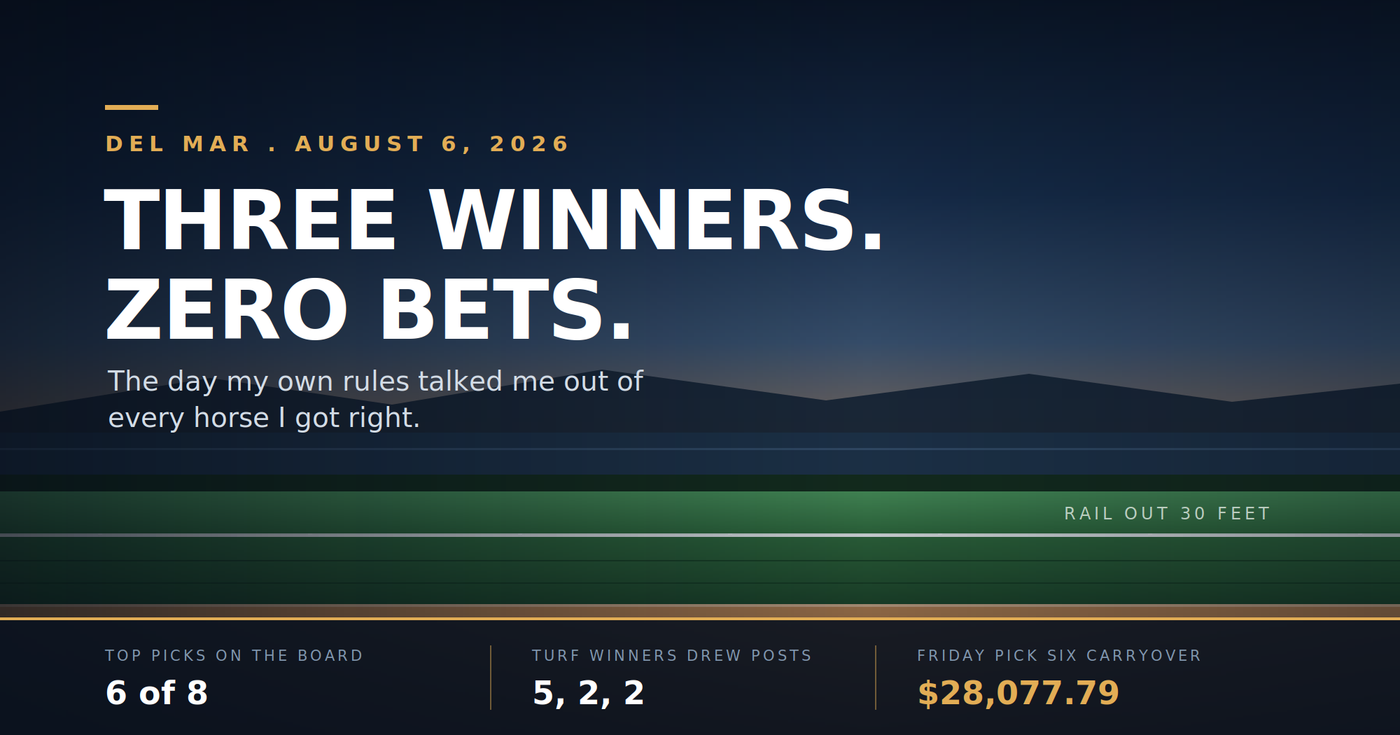
Del Mar, August 6 — the day my own rules talked me out of every horse I got right
I picked three winners on Thursday's eight-race card at Del Mar.
I did not have a dollar on any of them.
That is the whole story, and I want to walk through it honestly, because it's the most useful losing day I've had at this meet and I'd rather publish the autopsy than the highlight reel.
What actually happened
Nokie won the first at $4.60. Golden Sentry won the third at $8.40. Can't Say That won the fourth at $3.80. All three were the single named top selection on my sheet, written and published before the gates opened.
Here's how each one got away.
Nokie carried a price rule: bet at 5-2 or longer. She went off at 1.3-1. No bet.
Golden Sentry carried a price rule: bet at 7-2 or longer. He went off at 3.2-1. Missed the trigger by three-tenths of a point. No bet.
Can't Say That ran in a race I had declared a spread — a nine-horse pace meltdown where I'd written that I had no confident order. My own doctrine says no win bet in a spread race. No bet.
The only horse my rules did clear for a win bet was Saucier in the sixth, who owned the fastest speed figure on the entire card and finished somewhere behind seven other horses.
Final tally: eight races, six of my eight top picks hit the board, three of them won, and the card lost $123.80. A flat two-dollar win bet on every top pick — no rules, no filters, no thinking — would have made eighty cents.
Losing to a coin flip stings differently than just losing.
The $200 sentence
The most expensive thing I wrote all week was one line in the second race.
Jacklyn Lucas had broken her maiden a month earlier. I faded her with this: "Straight into $21,000 allowance company is two class levels at once."
She won at $50.60.
The 50-cent Pick 3 covering races one through three paid $205.30. I had race one. I had race three. She was the only leg missing, and adding her to the ticket would have cost me an extra four and a half dollars.
Put her on and nothing else changes: the card goes from minus $123.80 to plus $77.00.
So I went looking at every horse that beat me on Thursday, and the pattern was ugly in how clean it was:
| Horse | Result | Why I threw it out |
|---|---|---|
| Jacklyn Lucas | Won, $50.60 | Class jump too big |
| Liberty Cat | Won, $13.80 | Trainer 0-for-20 with debut runners |
| Busy Making Munny | 2nd | Never run a route |
| Lead the Way Kay | 2nd | Four years old, never raced |
| Anya | 2nd | Beaten fifteen lengths in her one good try |
Every single one was faded for something it hadn't done yet. Not one was faded because I could point at a rival and say that horse is faster, that horse is working better, that horse gets a better trip.
And look at where these races were run: maiden events and a bottom-level claimer. In a $6,250 claimer, "unproven" isn't a red flag — it's the entire field. When I throw out every horse with a thin résumé in a race full of thin résumés, all I've done is arrive at the same three horses everyone else has, at everyone else's price, while the winner comes out of the pile I swept off the table.
That's now a written rule, and it's the one I'm most confident will make money: a fade requires a rival, not an absence. If I can't name a specific horse that's better on figure, work or pace, the horse I want to throw out goes on the ticket anyway. I can still argue against it in the prose. The prose is where I have an opinion. The ticket is where I have a distribution. Those are not the same document.
About that grass
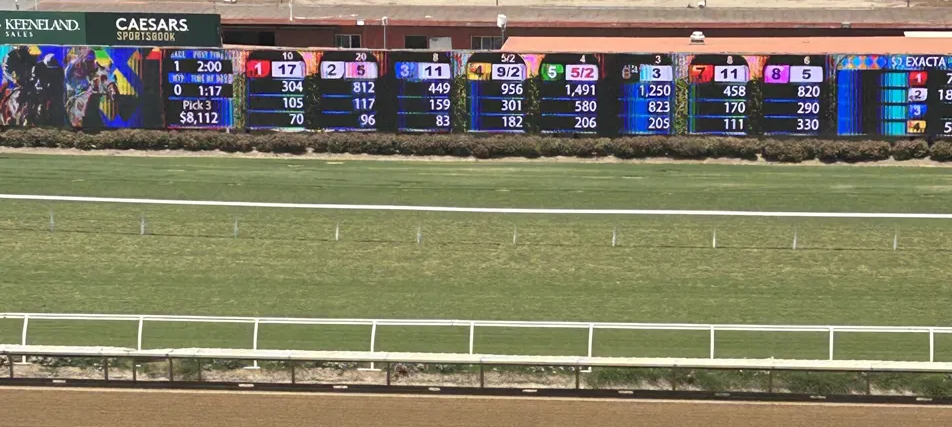
I took a photo from the grandstand on Thursday because the turf course looked wrong to me. There's a clear color break — dark, healthy green right along the rail, and lighter, tireder-looking grass out in paths two through five. My gut read was: the rail is dead today, stay off the inside.
My gut was reading a groundskeeping decision.
The temporary rail was set at 30 feet on Thursday, the widest setting logged all meet. That means the strip of turf between the permanent hedge and the temporary rail — thirty feet of it — carries zero traffic. It gets watered. It grows. Nobody runs on it. That lush green band I photographed isn't a dead rail, it's grass that no horse touched all afternoon. It can't have died, because nothing raced on it.
The lighter lanes further out? That's where horses have actually been running, at this setting and at the 12, 18 and 24-foot settings earlier in the meet. Worn turf is evidence of use.
And the results said the opposite of my gut, emphatically. Three turf races, three winners from posts 5, 2 and 2 — every one of them saved ground early and angled out late. The runner-up in the third came off the rail from post one.
But I did see something real on Thursday. I just diagnosed it wrong.
- Race 3: Chiseled in Stone came out hot on the lead and faded inside the sixteenth pole.
- Race 5: Hal of a Day was clear at the sixteenth and got run down.
- Race 7: Poor Connection stalked, pressed, took the lead, and yielded.
Three turf races. Three horses in front inside the last sixteenth. Three of them caught. That's not a path bias — it's a pace bias, and it's a far more useful thing to know. The winning trip on that grass was save ground, wait, tip out late, and run past a tiring leader. Atomic Age did exactly that from post two in the seventh and paid $10.00.
Worth noting alongside that: four cards logged now at rail settings of 12, 18, 24 and 30 feet. Three of the four played inside-friendly, including the widest one. The rail number has predicted nothing. I'm going to keep writing it down and I'm going to stop making predictions from it.
What I'm keeping
Six of eight winners were named somewhere on my sheet. Five of eight were on a horizontal leg. My top picks finished first, second, first, first, fourth, off-the-board, third, third. The handicapping is not the problem and hasn't been for two weeks.
The construction is the problem. It has been the problem on every card I've audited this meet, in a different costume each time. Thursday's costume was a set of price floors I'd chosen by feel rather than by math, and a fade discipline that was quietly eliminating exactly the horses that pay.
Both are now fixed on paper. We'll find out this weekend whether they're fixed in practice.
One thing worth flagging if you're heading down there: nobody hit the Pick Six on Thursday, and the carryover into Friday is $28,077.79.
Full audit — every ticket, every payoff, scored against the official Del Mar charts — is in the notes. Wager responsibly.